Today’s teenagers spent their childhoods outdoors, playing ball in the front yard, biking through neighborhoods and racing in and out the door, testing their luck, hoping their parents would give them just five more minutes outside in the blistering sun.
As those kids have gotten older, they’ve been introduced to technology that holds access to mind-numbing games meant to engage them for hours. The more access they’re given to these apps, the less time they spend outside, instead choosing to stay indoors and stare at a screen for hours on end.
Maybe it wasn’t an issue in the beginning, but as more research has been done and schools have noticed changes in student behavior, the effects of short-form content are making themselves known.
As social media usage rises and more and more content is being posted at a maximum length of three minutes, attention spans are becoming shorter and shorter. Recent studies from Dr. Gloria Mark at the University of California have shown that attention spans while on screens have gone from roughly 150 seconds to just 47 seconds in a matter of 20 years.
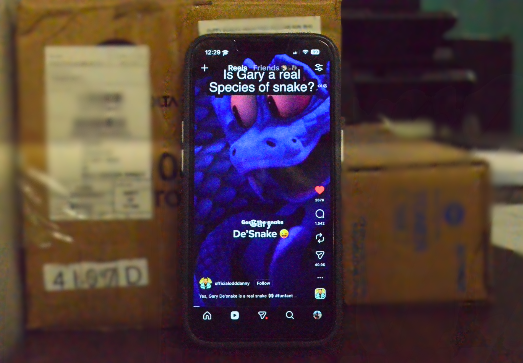
This has happened because of the ‘easy reward’ of doom-scrolling. Apps like YouTube, TikTok, and Instagram are made with short-form content that has quick, engaging videos made to catch your attention but only hold it for a short period of time.
As a result of this, people who spend a lot of time on these apps will have more trouble focusing on longer forms of content for longer periods of time, like movies, books, or even something as simple as waiting for a coffee, something that is really common in today’s teenagers.
The ‘easy reward’ comes from the subconscious curiosity of the unknown. The idea of not knowing what’s coming next and only having to scroll to find out is really appealing to some people, causing them to get sucked in and, before they know it, they’ve been scrolling for hours and nothing has gotten done.
In an article from the Swiss German University titled “The Decline of Attention Span in the Digital Era,” Flicka Miracle Simarmata says that scrolling apps use an engagement technique that is seen in slot machines known as variable reward schedules. When someone is scrolling through their phone, they can’t predict what’s coming next, releasing a hit of dopamine (a chemical in the brain that controls motivation and pleasure) because the ‘reward’ is just a quick swipe away.
Because of this, the system in place in classrooms is really unappealing to students because there is no quick dopamine release by sitting in class and focusing on their schoolwork. The students at Lakeland High School are no strangers to this kind of attention span; kids constantly say they can’t focus during class, and the reason why makes itself known when they pull out their phone any chance they get.
Freshman Kayla Zlateff said she spends a minimum of four hours on scrolling apps like TikTok and Instagram daily, and she’ll spend so long on it because she gets sidetracked when she opens the app. One video is all it takes for her to get sucked in and spend hours scrolling.
Zlateff said she’ll jump from one task to the other, getting easily bored and moving on quickly, though everything does get done eventually.
She said it is pretty easy to sit for a long period of time, but if it’s something she is not interested in, her mind wanders.
“It depends on the class or how interested I am in the class or topic we’re talking about,” Zlateff said.
Some students are able to focus for longer, but even then, they aren’t able to focus as well as kids twenty years ago could.
Junior Kylea Bartram said that she can focus for a while, but she’ll typically jump from task to task and will often have to have some sort of background noise going when doing a task in order to stimulate her mind.
“Most of the time, if I’m doing homework, I’ll have a YouTube video I’ve already seen on in the background,” Bartram said.
Bartram said that she spends roughly three hours a day on scrolling apps, and she feels as though that time spent on short-form content has decreased her attention span.
She does engage in other forms of long form content like reading, and because of this she is able to focus pretty well if she needs to, but sometimes, even though she is able to focus for long periods of time, she will be focusing so hard on trying to focus that she doesn’t catch what is being said to her.
Doom-scrolling every day can have really negative effects. A large study of just under 100,000 people showed that the more a person uses short-form content as entertainment, the more likely it is that person has a hard time focusing for long periods of time, often going off task and getting easily distracted.
The quick bursts of color and noise quickly engage viewers and train their brains to expect the quick kind of content. The longer the video, the harder it is for people to watch the whole thing without some form of distraction. That’s why videos with people talking need to have visuals and captions in order for the creator to get people to watch the whole thing.
This isn’t just happening to the younger part of the generation, either. Simarmata’s article said that even the older part of the generation is having trouble focusing on longer forms of content, with college professors saying there is a “‘crisis of focus’” in classrooms. Students will often choose to skim-read instead of actually read and understand the material.
Simarmata stated that deep thinking is the core foundation of a lot of aspects of life; “Without it, we become easily susceptible to oversimplified narratives and fake news.”
There are ways to avoid this, however, and it’s something kids hate hearing from their parents: limit screen time.
The benefits of limited scrolling can be seen through freshman Payette Walkington, who does not have access to scrolling platforms. Her short-form content comes from Pinterest, which doesn’t have a lot of quick bursts of color and noise to engage viewers. As a result, Walkington’s attention span is a lot longer than the average teenager.
Walkington spends a lot of time reading since she doesn’t have access to scrolling apps, and because of it, she is able to sit down and focus on the task at hand without background noise. She even said that if she’s doing two things at once, she cannot focus.
The kids at Lakeland did have some suggestions to reduce doom-scrolling. Walkington suggested reading more; just sitting down with a book and as much time as you have, and reading without stopping for anything but bathroom breaks.
Bartram suggested controlling screen time and not giving kids access to scrolling apps until they’re old enough to understand the consequences, but still limiting it so it doesn’t become an addiction.
Zlateff even went as far as suggesting the government control it, with kids not having access to certain apps until they age up enough to understand the consequences of the app.
There were also suggestions of taking away these apps entirely, and while this is usually seen by the older generation as a really effective solution, it isn’t the only one.
Shayliah Lassen said in her article “Brain Rot: How Short-Form Videos Are Changing Our Brains and Attention Spans” that balance is the key. Taking away the apps doesn’t have to be the only solution. By simply limiting yourself, you can force yourself into hobbies that will increase your attention span.
Lassen stated that “with healthier digital habits and more awareness around screen time, you can enjoy the benefits of social media without sacrificing you attention, mood, or mental clarity.”